

A portfolio tracker can bring exchange balances, wallet holdings and supported on-chain positions into one view. For a DeFi borrower, the important question is not just “What is my crypto worth?” It is “What do I own, what do I owe, and how close is each loan to its protocol’s liquidation conditions?”
No tracker sees every account or updates every position instantly. Use its dashboard to frame decisions, then verify critical figures against the lending protocol and your underlying transaction records. Monitoring gives you time to assess a risk; it cannot prevent liquidation.
What a tracker can—and cannot—show
A basic price app shows a market quote. For example, a hypothetical Bitcoin move of 4% tells you little about your own gain or loss without your purchase history. A portfolio tracker may add balances, transaction history, estimated cost basis and performance. Its total is only as complete as the accounts, protocols, prices and debt it recognizes.
That distinction matters when you hold assets on an exchange, supply collateral to a lending protocol and put other assets into a liquidity pool. A wallet’s visible token balance may omit collateral held in a contract, unclaimed rewards or an outstanding loan. Conversely, counting a deposited asset and the token representing its deposit as two separate holdings can overstate your position.
Look for separate views of assets, liabilities and net position. Check when each source last updated. A displayed profit-and-loss figure is an estimate until deposits, withdrawals, transfers, fees and older prices have been reconciled.
Choose a tracker around your actual accounts
Start with a list of the exchanges, wallets, chains and protocols you use. Test support for those specific positions rather than relying on a headline integration count. Before importing a full history, try a small wallet or account and check:
- Coverage: Does it identify your collateral, loan balance, liquidity positions and any relevant rewards, or only the tokens in your wallet?
- Refresh and history: When do exchange and protocol figures update? Can you import records from an account you no longer use?
- Transaction handling: Does it distinguish your own transfers from sales and avoid double-counting wrapped or deposited assets?
- Records and exports: Can you download transactions, tags and valuation history in a format you and your tax preparer can review?
- Access and cost: Which accounts, transactions or features are covered by the plan you are considering?
Reconcile the imported balances with each exchange and protocol directly. Spot-check older transactions, especially transfers between your own wallets, bridges, swaps and loan activity. Fixing an import error early is easier than relying on it for months.
Connect accounts with limited permissions
For an exchange connection, create an API key with only the viewing permissions the tracker needs. Permission names vary: Coinbase Exchange, for example, distinguishes View, Trade and Transfer permissions. Check the settings on your own exchange rather than assuming a key is read-only. For an on-chain wallet, a public address can provide watch-only visibility. CSV or manual imports can fill gaps where a connection is unavailable.
Never enter a seed phrase or private key to set up watch-only tracking. Limited permissions reduce what a connected service can do with your account; they do not remove privacy or account-security risk. Linking public addresses to a profile can reveal a detailed map of your activity.
Review the tracker’s account security, data-retention policy and export options. Also distinguish tracking from other kinds of connected software: a vendor’s description of non-custodial architectures concerns its own exchange-connected service, not a guarantee about your tracker or your data. Before committing historical records to any provider, confirm that you can take a usable copy with you.
Monitor the whole borrowing position, not just the collateral price
When crypto secures a loan, a falling collateral value or growing debt can bring the position closer to liquidation. Track collateral value, outstanding debt, accrued borrowing interest and the protocol’s position-health measure together. Current loan-to-value (LTV) is debt divided by collateral value, but a borrowing limit is not necessarily the same as a liquidation threshold.
For a simple illustration, suppose collateral is worth $10,000 and debt is $4,000. The current LTV is 40%. If that collateral falls to $8,000 while the debt stays at $4,000, LTV rises to 50%. The example does not establish when a real loan would be liquidated: eligibility depends on the protocol’s rules, collateral type, debt and changing position values. On Aave, the health factor incorporates collateral value, applicable liquidation thresholds and borrow value; a health factor below 1 makes a position eligible for liquidation.
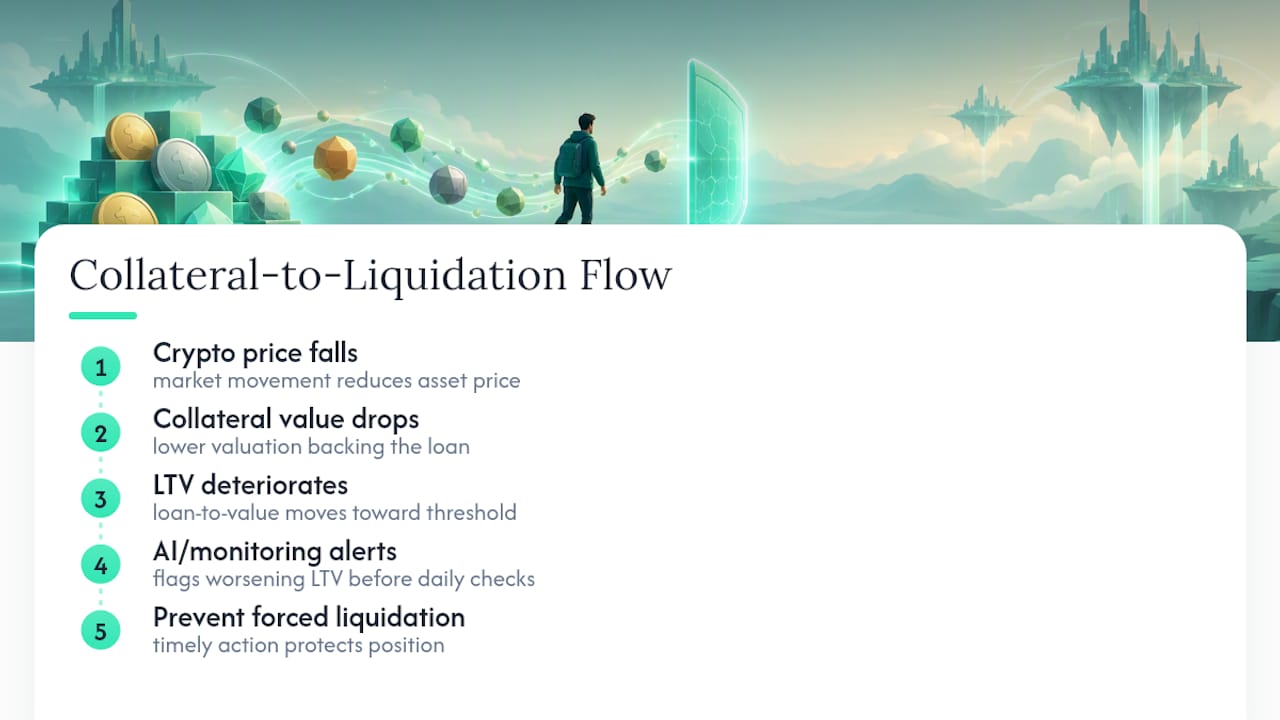
Check the lending protocol itself for its current parameters and your position’s status. Consider adverse-price scenarios before you borrow and revisit them as interest accrues. If a dashboard lacks debt or uses a delayed collateral price, its net-worth figure may look comfortable while the loan becomes less healthy. The borrowing-risk guide provides more context on liquidation mechanics, but no guide, tracker or alert can rule out a forced liquidation.
Borrowing is a separate decision from investing the proceeds. It adds interest, collateral and protocol risk. If borrowed funds go into a liquidity pool, assess its fees, position-value changes and protocol risks alongside the financing cost. Borrowing does not alter the pool’s impermanent-loss mechanics, and LP fees are not a promise that the combined position will earn more than it costs.
Read DeFi and performance figures carefully
Staking rewards, liquidity positions, restaked assets and NFTs can be difficult to value consistently. A tracker might omit unclaimed rewards, misunderstand a bridged position or use an NFT floor price that is a poor estimate for an individual item. For a consequential decision, compare the displayed position with the protocol’s records and the underlying transactions.
Historical charts are most useful when they answer a specific question: after transaction fees, borrowing interest and changes in position value, did a strategy improve your net result? Compare like-for-like periods and account for deposits and withdrawals; otherwise a rising chart may reflect money added rather than a gain. Separate realized results from changes in the estimated value of assets you still hold.
Allocation drift is another measure, distinct from a fall in total portfolio value. If you read about a 5% rebalancing band, check whether the band describes a change in an asset’s portfolio weight, measured in percentage points. It is not automatically a sensible loss-alert setting for your portfolio.
Use tax exports as records to review, not answers to accept
Transaction exports, historical prices and estimated cost basis can make recordkeeping easier. They cannot determine your tax liability from balances alone. Missing acquisition history, an incorrectly labeled transfer or a misread DeFi transaction can change the result. Check the tax-lot method your software applies against the rules that govern your filing; a menu of methods is not permission to use every method.
For US taxpayers, the IRS says digital-asset records should include information needed to establish basis and the transaction’s fair-market value. A transfer between wallets you own is generally different from a sale, although using digital assets to pay a transfer fee can have its own consequences. Swaps, rewards, collateral movements and liquidation require attention to what actually happened. Local-currency reporting and tax treatment vary by jurisdiction, so preserve transaction-time price and conversion records where relevant.
Institutional discussions of fair-value accounting and real-time reporting illustrate why timely valuation records matter to financial reporting; they do not set an individual’s tax method. For personal records, retain both the raw history and any corrections you make to a tracker’s classifications. If you are comparing borrowing with selling, review the distinct tax questions raised by crypto loans and capital gains rather than assuming that every step of a borrowing strategy has one tax outcome.
Test mobile access, backups and alerts before relying on them
Check what your chosen product actually offers on your devices. Does its mobile view show the same debt and collateral data as the web view? Can you export records independently of the app? What happens if a connection stops refreshing or you lose account access? Save a copy of important transaction records outside the tracker.
Where alerts are available, distinguish market-price notifications from position-health notifications. A hypothetical 2% price-trigger notification tells you a market price crossed a setting; it does not, by itself, report your loan’s health factor. Check whether your service supports the particular account and position you need, then test delivery. Notifications can be late, unavailable or missed, so they should supplement—not replace—direct checks of a borrowing position.
A practical first-week checklist
- List your wallets, exchanges, collateral, loans and DeFi positions; note what the prospective tracker does not support.
- Connect a test account using watch-only access or the minimum exchange API permissions needed. Never provide a seed phrase.
- Compare balances and debt with the original platforms, then spot-check transfers and older transaction prices.
- Record where to find each loan’s current health measure and protocol parameters. Consider what a drop in collateral value or an increase in debt would mean for that position.
- Export your records and test any alerts without assuming that an alert will arrive in time to act.
A clear view of holdings and debt can also help you ask better questions. OverseasDeFi’s portfolio and position tools and portfolio-context AI coaching support that learning alongside human guidance; they do not replace protocol checks or decisions about whether borrowing fits your circumstances. The learning hub offers further background on those choices.
FAQ
Can a portfolio tracker prevent liquidation?
No. It can help you see collateral, debt and position health if it supports the protocol and has current data. Prices, debt and protocol conditions can change before you see or act on an update.
What should I check before choosing a tracker?
Confirm support for your actual accounts and DeFi positions, how frequently they update, whether liabilities appear, and whether you can reconcile and export the full transaction history. Test with a small account before depending on the total.
Is a read-only connection safe?
It limits account permissions when configured correctly, but it does not eliminate data or account-security risks. Verify the exchange’s permission settings, protect the tracker account and never supply private keys or a seed phrase for watch-only tracking.
Can I file taxes using a tracker’s report?
Use it as a starting record, not a final determination. Review missing history and DeFi classifications, keep the underlying transactions, and apply the rules for your jurisdiction and circumstances.
How do I judge whether borrowing to earn fees is worthwhile?
Consider loan interest, collateral and liquidation risk, pool fees, changes in the pool position’s value and protocol risk together. Fee income alone does not show whether the combined position has gained value.
Further reading
- Borrowing Against Crypto vs. Selling
- How Crypto-Backed Loans Work
- For an institutional financial-reporting perspective, see Crypto asset management best practices | Stripe.
- For a vendor’s description of an exchange-connected trading service, see Crypto asset management platform | Cornix.