


If you’ve held Bitcoin or Ethereum for a few years, you’ve probably had the same thought at 11 p.m. while checking a price chart: this coin just sits there, and I’m the one doing all the work. Two ideas usually follow. Trade it more actively, or put it to work earning yield.
They sound similar. They aren’t. Day trading asks you to be right about price, again and again, on a schedule the market sets. DeFi yield asks you to understand how a financial service pays you, then manage the risks of that service. For most professionals and parents who already own BTC or ETH and don’t want to sell, the second one fits real life better. At OverseasDeFi, that’s the approach we teach, and this article lays out the reasoning so you can check it against your own situation.
Overseasdefi5steps.overseasdefi.comPut Your Crypto to Work CarefullyExplore income-generating strategies for Bitcoin and Ethereum with practical education, risk guidance, portfolio tools, and human support.5 steps to earning daily IncomeTL;DR
- Day trading is a bet on short-term price moves and needs frequent attention, including nights and weekends, because crypto trades around the clock. DeFi yield is income from lending, borrowing and liquidity fees, and it works on a calendar you control.
- Yield isn’t free money. Fees, impermanent loss, rate swings and liquidation risk can all cut returns, and the research below shows how.
- If you want to keep your BTC or ETH and get cash flow, one framework we teach is working out whether borrowing against it and deploying the proceeds fits your situation. Borrowing adds interest, liquidation and smart-contract risk, and deposited funds are held by protocol contracts.
- Start with a realistic target and a written risk limit before you deposit anything.
Table of Contents
- What each approach actually asks of you
- Where DeFi yield comes from, in everyday terms
- What returns look like in practice
- What day trading demands that yield doesn’t
- The risks of yield, laid out honestly
- Which one fits you?
- How to start without overreaching
- How we help at OverseasDeFi
- FAQ
- Sources
What each approach actually asks of you
Let’s strip both down to the job description.
Day trading means opening and closing positions within a day, trying to profit from small price moves. You need a view on direction, a stop-loss plan, quick execution and the nerve to take losses. Your income depends on being right more often than wrong, after fees. There’s no paycheck on the days you’re wrong, and the days you’re away from your screen are days you can’t act.
DeFi yield means earning income because your assets provide a service. Someone lends against collateral and pays interest. A trader swaps tokens and pays a fee to the pool that makes the swap possible. Galaxy Research describes the main sources as lending and borrowing, staking and restaking, structured strategies, and liquidity-provision fees and incentives. You aren’t predicting where the price goes tomorrow. You’re being paid for providing something people use.
Here’s a plain comparison:
| Day trading | DeFi yield | |
|---|---|---|
| Where income comes from | Price moves you correctly call | Interest and fees paid by borrowers and traders |
| Time commitment | Daily, at any hour, since crypto trades 24/7 | Setup time up front, then regular check-ins |
| Core skill | Timing and discipline under pressure | Understanding mechanics and managing risk |
| Main way it goes wrong | Being wrong on direction, over and over | Fees, impermanent loss, rate drops, liquidation |
| Do you have to sell your BTC or ETH? | Usually you’re trading in and out of positions | Not necessarily, you can keep long-term exposure |
The last row is why this comparison matters to a long-term holder. If you believe in your Bitcoin and don’t want to sell it, trading it actively works against that belief. Earning from it doesn’t.
Where DeFi yield comes from, in everyday terms
Think of a neighborhood tool-lending library. Some people drop off drills and ladders. Other people borrow them and pay a small fee. The library pays the lenders out of those fees. DeFi money markets work roughly that way, only with crypto and smart contracts instead of a librarian.
Galaxy’s research explains that in onchain lending, depositors supply assets to a money market, and borrowers draw against that pooled liquidity at variable rates. Loans are overcollateralized, meaning borrowers put up more value than they take out. If a position’s margin falls below a safety threshold, a smart-contract liquidator steps in automatically. In practice, the position becomes eligible for liquidation: outside liquidators, usually bots, repay part of the debt through the contract and receive part of the collateral at a discount. Rates float with demand. We cover how those rates get set in our guide to DeFi interest rate models.
Liquidity providing is the other big source. You put two assets into a trading pool and earn a share of the fees when people swap between them. It’s a different animal from lending, with its own risks, which we’ll get to. If the terms are tangled in your head, our explainer on yield farming versus liquidity mining sorts them out.
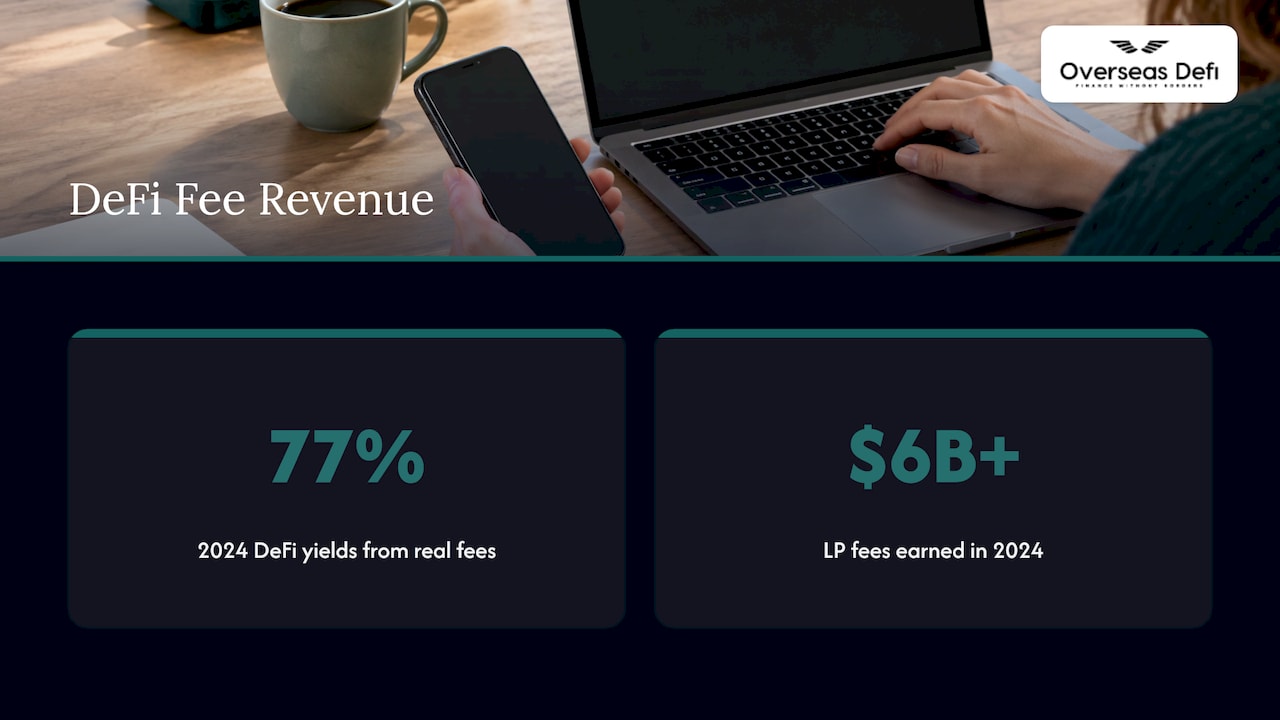
One encouraging data point: The DeFi Yield Renaissance report (February 2025), which draws on DefiLlama data, said 77% of DeFi yields in 2024 came from real fee revenues, and liquidity providers earned more than $6 billion in fees that year. The report reads that shift toward fee-based yield as healthier than yield paid in newly issued reward tokens, since fees are tied to services people actually use. Yield backed by real usage is easier to reason about than yield backed by a token’s hype.
What returns look like in practice
This is where it pays to slow down: a big percentage on a dashboard isn’t necessarily yours.
Galaxy Research reported that stablecoin APRs on Ethereum lending markets ranged from below 2% in late 2022 to brief 15% spikes in Q1 2024. For the period it studied, the report put the seven-day average around 5% to 6%, with money-market deposits above $80 billion against loans near $35 billion. That works out to roughly 40–44% of deposits lent, an imbalance that kept lending rates in the mid-single digits. Those are figures for that period, and they move with borrowing demand, so treat them as a picture of the range rather than a promise.
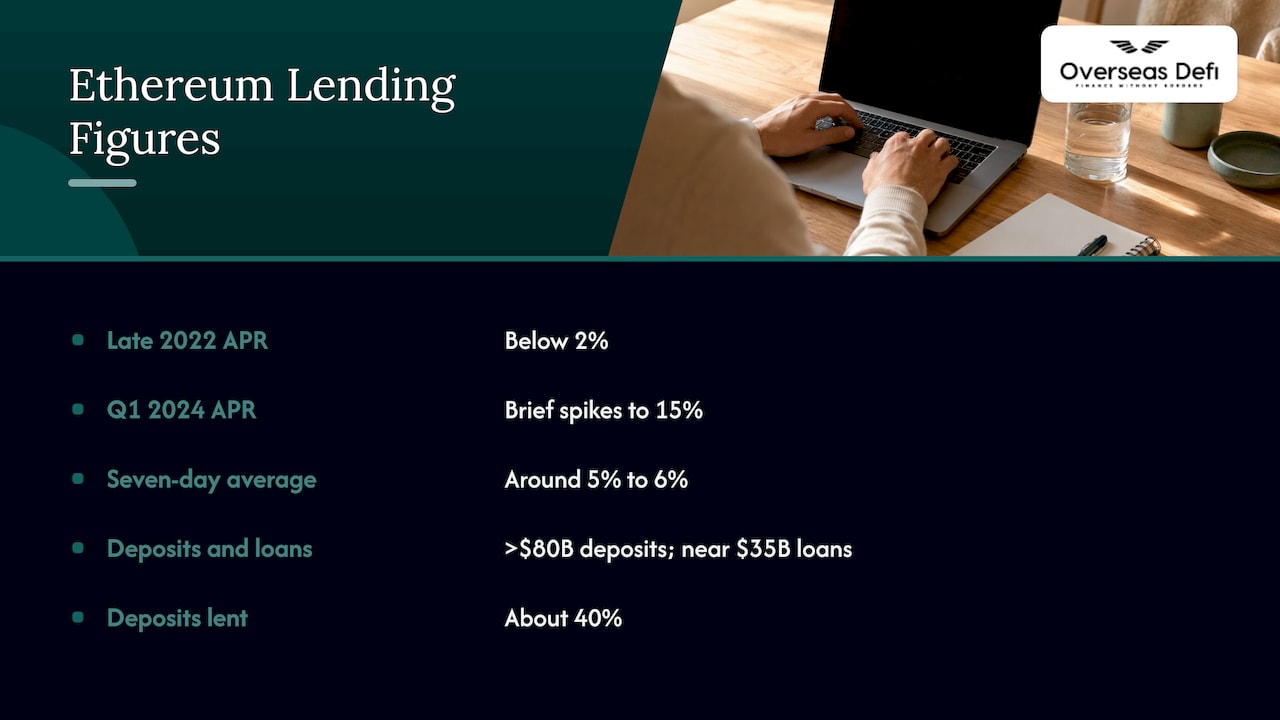
The lesson is in the shape. Lending yields are cyclical and tied to borrowing demand and utilization, so a temporary high rate shouldn’t be assumed to last. A sensible plan is built on the boring middle of the range, not the spike.
For liquidity pools, the sobering evidence comes from academic research on crypto yield farms. In a working paper by Patrick Augustin, Roy Chen-Zhang and Donghwa Shin, the authors report that transaction costs, including gas, trading fees and price impact, reduced return performance. They also found that farms advertising the highest headline yields recorded the most negative risk-adjusted returns. Costs that a headline rate doesn’t show, such as impermanent loss and transaction costs, help explain how a big number can turn into a poor deal. In plain English, the flashiest number tended to be the worst deal on a risk-adjusted basis.
Impermanent loss, if it’s new to you, is the gap between holding two assets and putting them in a pool when their prices move apart. We walk through it with numbers in Impermanent Loss Explained for Liquidity Providers. For a calmer view of targets, see what’s realistic in DeFi.
What day trading demands that yield doesn’t
Day trading isn’t impossible, and some people do it well. The question is whether it fits your life.
Three practical issues come up for busy professionals:
- Attention. Crypto trades around the clock. If you’re a surgeon, an attorney or a parent of three, your best trading hours collide with your actual job and your actual family.
- Emotion. Every trade is a small decision under stress. Even disciplined traders hit rough patches, and writing about losing streaks in trading is its own genre because they’re a normal part of short-term strategies, not a sign that something is wrong with you.
- Taxes on every move. In the US, selling or swapping crypto can create a taxable gain or loss each time. A high-frequency approach means a lot of records to keep. That’s not a reason to panic, only a reason to plan. Our guide to how US crypto rewards are taxed explains income at receipt and gain or loss at sale. Check your own situation with a CPA.
DeFi yield has its own homework, and it’s better to say so up front. But the homework is front-loaded: you learn the mechanics, set limits, and then check in on a schedule. Our walkthrough on yield schedule planning shows what that looks like week to week.
The risks of yield, laid out honestly
If a strategy only sounds good when the risks are left out, it isn’t ready. Galaxy’s report names several risks in DeFi lending: liquidity mismatch, concentrated liquidations, speculative rate volatility and access constraints. Here’s what they mean for you.
- Liquidation risk. If you borrow against BTC or ETH and the price drops far enough, your position can be liquidated: outside liquidators repay part of your debt and receive part of your collateral at a discount, so you lose more than the price drop alone. Keeping a wide buffer is the main defense. Our guide on the stablecoin loan strategy covers how to borrow while keeping your BTC.
- Rate risk. The rate you earn can fall after you deposit. Build plans that still work at the low end.
- Smart-contract and stablecoin risk. Code can fail and stablecoins can slip off their peg. See stablecoin risk for BTC and ETH holders and stablecoin yield risks.
- Impermanent loss and fees. Covered above. They’re the quiet leaks in liquidity pools.
- Your own mistakes. Sending funds to the wrong address or approving the wrong contract is a very real way to lose money. A pre-deposit routine helps, and our guide to DeFi insurance and risk protection covers another layer of protection.
None of this makes yield a bad idea. It makes it a skill. The point of learning it with structure is to find the failure modes on paper, not with your savings.
Which one fits you?
Try these questions. Answer fast, then slow.
You probably lean toward DeFi yield if:
- You hold BTC or ETH for the long run and don’t want to sell it.
- You’d like income on a rhythm that doesn’t depend on watching charts.
- You can spend a few focused hours learning mechanics, then a short check-in each week.
- You’d rather manage a risk buffer than make fifty price calls a month.
You probably lean toward day trading if:
- You enjoy markets as a craft, and you have hours of screen time available.
- You’re comfortable with frequent losses as part of the process.
- You’re using money you can afford to see swing hard.
Plenty of people sit in the first group without realizing it. They bought years ago, held through ugly drawdowns, and still believe in the asset. What they lacked wasn’t conviction, it was a way for the holding to contribute something while they wait. That’s the gap earning yield without selling is built for.
How to start without overreaching
If you go the yield route, here’s a sensible order. Wallet security comes first, as it does in everything we teach.
- Secure your wallet first. Hardware wallet, recovery phrase offline, no shortcuts. Everything else sits on top of this.
- Decide what you won’t risk. Pick a share of your holdings you’ll deploy and a share that stays untouched. Write it down.
- Set a modest yield target. Base it on the middle of the range, not the best week on record. Our guide to realistic crypto yields is a good reference.
- Understand the tax treatment before you earn. Rewards and gains are treated differently in the US, so know which is which.
- Start small, observe, then scale. A small first position teaches you how gas, fees and rates behave in practice.
- Review on a schedule. Check collateral buffers, rates and protocol news at set times, not whenever anxiety strikes.
If you want the whole routine in one place, five steps to daily crypto income puts it together.
How we help at OverseasDeFi
OverseasDeFi teaches long-term Bitcoin and Ethereum holders how to earn income from crypto they already own, through the Daily Yield System, an educational framework (Hold → Borrow → Deploy → Earn) that helps you assess whether borrowing and deploying fits your situation, without day trading. We provide education, tools and coaching. You keep control of your assets and make your own decisions: we don’t take custody of funds or manage investments for you.
There are two ways to work with us. Community and Accelerator offer different levels of support. Depending on the tier, that can include coaching, community and macro calls, tools to see your positions and risk together, and an AI coach that can take your holdings into account. Check the site for current details.
If that sounds like the right level of structure, you can look at Community and Accelerator and see which fits. No rush. A good first step is simply reading one of our guides and seeing whether our plain-English style works for you; the Learn section is a decent place to begin.
FAQ
Is DeFi yield more profitable than day trading?
Neither has a guaranteed return, so profit depends on execution and risk. Day trading profits come from correct price calls, while DeFi yield comes from interest and fees that fluctuate with demand. The research above shows lending yields cycling between low single digits and brief spikes, so plan around the middle of the range.
Can I earn yield without selling my Bitcoin or Ethereum?
Yes, it’s possible, and assessing whether it fits you is part of what we teach. Borrowing against BTC or ETH lets you keep the holding while deploying borrowed funds, but you pay interest, take on liquidation risk if prices fall, and add smart-contract risk. Tax treatment depends on the transaction and where you live, so a generous collateral buffer and a CPA conversation both matter. Our guide on earning yield without selling goes step by step.
Is DeFi legal in the US?
Using DeFi protocols isn’t illegal in itself, but tax and reporting rules apply to what you earn and sell. The IRS treats crypto as property, so income and gains need to be tracked. Talk with a CPA about your own situation, and see our overview of US crypto rewards taxes.
How much time does DeFi yield take each week?
It takes more time at the start, while you learn the mechanics and set up securely. After that, a routine of scheduled check-ins can replace constant monitoring, though volatile markets may call for closer attention. Day trading, by contrast, tends to need your attention at all hours, since crypto trades around the clock.
OverseasdefiTalk Through Your Yield OptionsReach out with questions about learning DeFi strategies, understanding their risks, and exploring ways to generate income while retaining control of your crypto.OOverseasdefiEmail usRoman.rida@overseasdefi.com+1 310 569 7547Sources
- Mapping DeFi Yield: From Stablecoins to Restaking, Galaxy Research (published by Galaxy as The State of Onchain Yield: From Stablecoins to DeFi and Beyond)
- The DeFi Yield Renaissance, DefiLlama Research
- Reaching for Yield in Decentralized Financial Markets, University of Delaware (working paper by Patrick Augustin, Roy Chen-Zhang and Donghwa Shin; PDF hosted by the University of Delaware)
- Losing Streak in Trading: What to Do and Why Challenges Expect It