


Most people hear “diversify” and think “buy more coins.” In DeFi that instinct misses the biggest risks. Your Bitcoin and Ether can sit untouched in a wallet, and the thing most likely to hurt you is a single lending protocol, a single liquidity pool or a single loan sized too aggressively. Diversification in DeFi means spreading risk across protocols, collateral, strategies and time, so one failure doesn’t take the whole plan down with it.
We teach this to members of OverseasDeFi who want income from the BTC and ETH they already hold, without selling. Below is the plain-English version: what to spread, how much, and which risks diversification can’t fix.
OverseasdefiUnderstand DeFi Risk Before ActingExplore practical education on protocols, collateral, and strategy risks while learning how to use existing crypto without selling it.5 steps to earning daily IncomeTL;DR
- Owning many coins isn’t DeFi diversification. Major crypto-assets tend to move together, so the bigger risks to spread are protocols, collateral and strategies.
- A strategy that chains protocols together can fail as a chain. One hack can reach every layer built on top of it.
- Cap how much of your income plan sits in any one protocol, keep your loan-to-value (LTV) low, and keep some capital out of DeFi entirely.
- Diversification doesn’t remove smart-contract risk, liquidation risk or exit risk. It limits how much any one of them can cost you.
- Review the plan on a schedule. Protocol risk settings and your collateral’s price both move.
Table of Contents
- What diversification means in DeFi
- Why owning more coins isn’t enough
- The real concentration risks sit inside the protocol
- A worked example: borrowing against BTC without selling
- Diversify the plumbing: collateral, loans and liquidation
- Staking and receipt tokens: a hidden layer
- Sizing positions and rebalancing
- What diversification can’t do
- How we teach this at OverseasDeFi
- FAQ
- Sources
What diversification means in DeFi
DeFi, short for decentralized finance, is a set of financial services built on blockchains and smart contracts instead of banks and brokers. The Congressional Research Service describes it as financial activities and services facilitated by cryptocurrency and meant to run without traditional intermediaries, and puts total value locked in DeFi at about $98 billion as of March 2026.
In a normal portfolio, diversification means holding different assets so one bad performer doesn’t sink you. In DeFi you have a second job. You’re also choosing where your assets sit and what they’re doing. The same ETH can be idle in a wallet, posted as collateral for a loan, or paired in a liquidity pool. Each of those places has its own code, its own rules and its own ways to fail.
So think of DeFi diversification in four layers:
- Assets. What you hold and use as collateral.
- Protocols. Which lending markets, exchanges and pools your funds touch.
- Strategies. Borrowing, providing liquidity, staking, or simply holding.
- Time and size. How much you commit, and when you can get out.
If you’ve ever heard the textbook answer to “what are two types of diversification,” it’s usually across asset classes and within an asset class. DeFi adds a third you can’t skip: across the platforms that hold your assets.
Why owning more coins isn’t enough
It’s tempting to fix concentration by adding altcoins. The evidence says that doesn’t buy much. A 2022 academic survey of synthetic assets found that the ten largest coins by volume were positively correlated with each other, and that a wallet full of positively correlated coins may not get meaningful diversification benefits. The OECD found a related pattern: major crypto-assets showed medium-high and rising positive correlations with traditional asset classes, which limits how much crypto diversifies a traditional portfolio.
In plain terms, when the market gets scared, most tokens fall together. Ten coins in a crash behave like one big coin with extra steps.
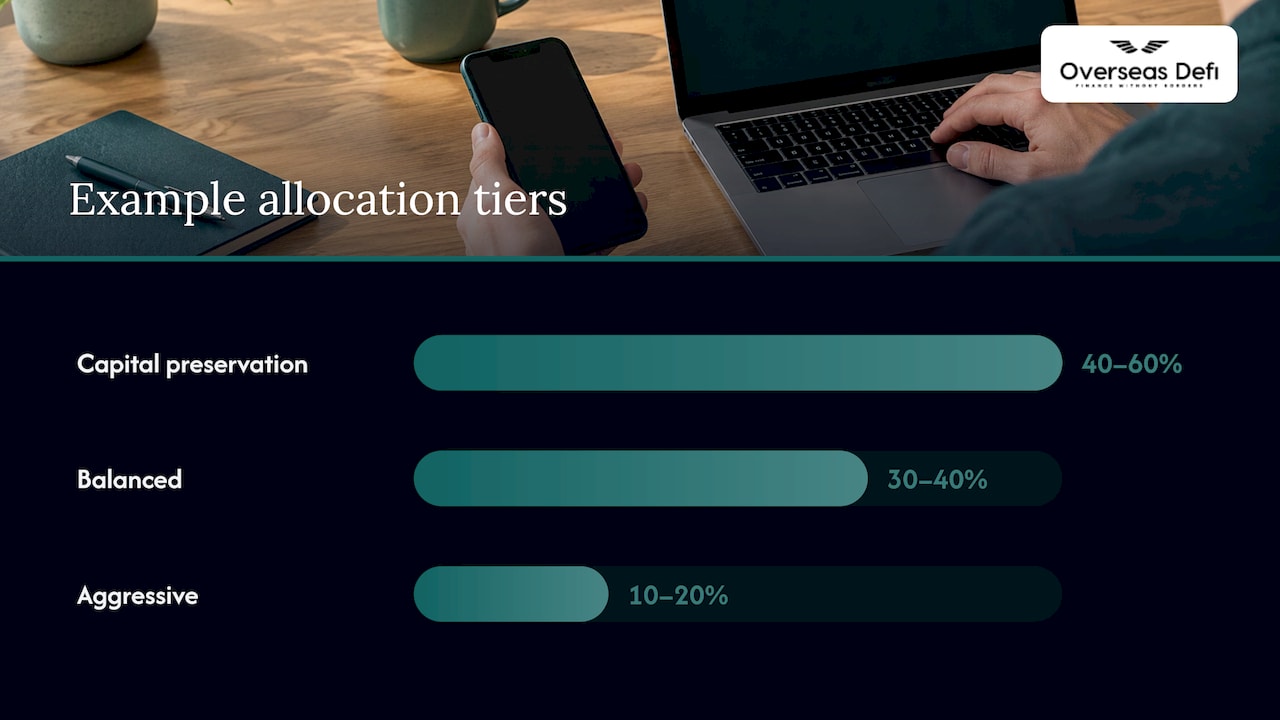
That’s why it can make more sense to spend diversification effort on how BTC and ETH are put to work than on adding more coins. If you want a size reference for the whole crypto sleeve of a portfolio, one contributor to a Swiss Finance Institute roundup suggests 1% to 3% of total wealth in a diversified crypto portfolio. That’s one professional’s view for one client type, not a rule. Your own number depends on your income, your family’s needs and how you’d feel in a 60% drawdown.
The real concentration risks sit inside the protocol
Here’s where most holders get surprised. Smart contracts are code, and code can have bugs. A 2022 academic paper on managing DeFi portfolios points out that liquidity pools created by these contracts act as a single point of failure, and that hackers commonly exploit breaches to steal pool tokens. Its advice is to spread allocation according to each protocol’s risk, including the different risk of different stablecoin types.
The same paper explains how failures travel. A protocol hack rarely touches the host blockchain or the token’s own code, but contagion spreads through yield farming. In its example, a hack on one auto-compounding vault (a yield aggregator) would hit the exchange and the lending market it was chained to, because the strategy links them together.
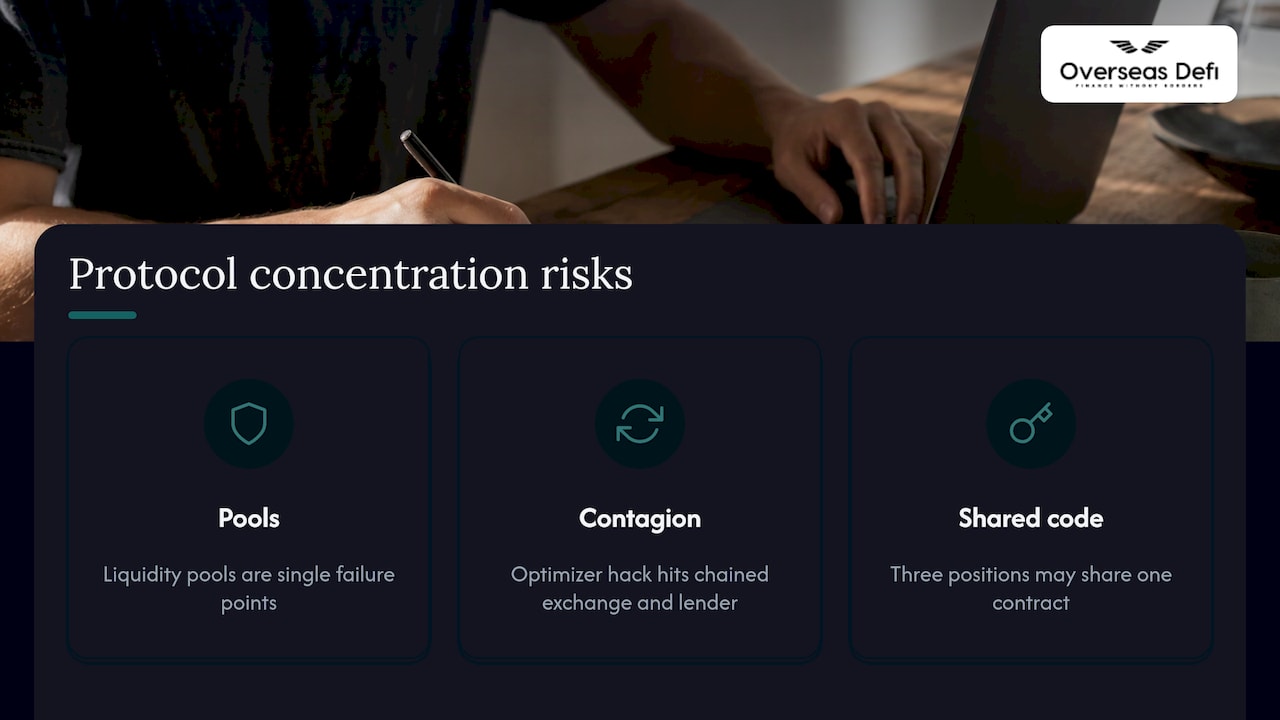
That’s the part a coin count never shows you. Three “different” positions can all depend on the same underlying contract. Before you call a plan diversified, ask one question of each position: if this one protocol failed tomorrow, what else would fail with it?
We go deeper on this in our guide to cross-protocol diversification for BTC and ETH holders, and the 15-minute pre-deposit check for liquidity pools is a useful habit before any new deposit.
A worked example: borrowing against BTC without selling
Let’s make this concrete with a hypothetical. This is an illustration of structure, not a result anyone achieved or a recommendation.
Say you hold $200,000 of Bitcoin and don’t want to sell it, maybe because selling could create a tax bill where you live, or you simply believe in the long run. The academic paper above describes one well-known structure that keeps Bitcoin exposure: post wrapped BTC as collateral on a lending protocol, borrow stablecoins, then deposit those stablecoins in a liquidity pool to earn fees, optionally adding an auto-compounding vault on top.
Now the diversification questions:
- How much do you borrow? Borrowing $30,000 against $200,000 is a 15% loan-to-value. Borrowing $100,000 is 50%. The lower the LTV, the more your collateral can fall before the lender can liquidate you. Our guide to stress-testing your LTV walks through the math.
- Where does the borrowed money go? Putting all $30,000 in one pool means one contract decides the outcome. Splitting it over a few pools on different protocols, and keeping a slice in plain stablecoins in your own wallet as a buffer, means no single failure takes all of it.
- What’s the loan itself exposed to? The collateral sits in a lending protocol too. That’s another protocol you’re depending on.
The paper’s own approach is to weight each protocol by a risk score rather than splitting money equally, so a riskier protocol gets a smaller share (see 30 to 40% of a given yield category for the paper). Treat that as a way of thinking, not a formula, and write down your own maximum per protocol before you deposit.
Diversify the plumbing: collateral, loans and liquidation
Lending protocols protect themselves with rules. The international securities regulators’ body IOSCO describes these as risk parameters such as loan-to-value ratios, liquidation ratios, liquidation bonuses and reserve factors, which vary by collateral asset and its risk. Loans are generally over-collateralized, meaning you post more value than you borrow, and there are no credit checks because users are pseudonymous.
That last point matters for a family. There’s no phone call before a liquidation. If your collateral drops far enough, the protocol sells it automatically, and the sale usually comes with a penalty. A few habits spread that risk:
- Keep LTV well below the protocol’s maximum, so a sharp drop leaves room.
- Don’t put every coin you own behind one loan. Where a protocol or account setup keeps positions isolated, several smaller loans let you add collateral to or repay one without touching the others. On pooled-collateral markets, all borrows in one account share the same health factor.
- Hold some stablecoins outside DeFi, ready to repay part of a loan quickly.
- Know your plan for a fast drop before it happens. Our guides on how crypto loan liquidation works and paying down DeFi loans safely cover that.
Gauntlet’s market risk assessment of Aave, published on Aave’s governance forum, lists four main market risks: extreme price drops that leave loans under-collateralized, illiquid assets with liquidators not acting, cascading liquidations, and slashing of the safety module. Cascading liquidations is the one worth picturing: forced selling pushes prices down, which triggers more forced selling. Low LTV and spread-out positions are your protection against being part of that cascade.
Staking and receipt tokens: a hidden layer
Many ETH holders use staking or liquid staking, where you get a receipt token back that you can use elsewhere. That can add another layer of dependency. A Digital Economy Initiative paper submitted to the SEC’s Crypto Task Force in April 2025 notes that lockup and unbonding periods can stop an owner from exiting promptly when a token’s price crashes, and that if a delegee becomes insolvent, a beneficial owner could lose access to tokens. The paper also notes that when receipt tokens are used as collateral in DeFi, slashing or a sharp fall in the token’s value can have destabilizing effects, a risk it compares to rehypothecation in traditional finance.
The practical read for diversification: don’t stack the same asset through several wrappers and call it three positions. If you use stETH as collateral, understand its health factor and liquidation mechanics, and size it as one concentrated bet on that whole stack.
The European regulators’ 2025 joint report on crypto-assets raises a related point: providers may change fees, interest rates or yields and collateral requirements, and it flags excessive borrowing as a risk of lending, borrowing and staking. Yield isn’t a fixed number. That’s another reason not to plan your household cash flow around one source.
Sizing positions and rebalancing
Spreading out is half the job. The other half is keeping the plan from drifting. A pool that does well grows to a bigger share of your DeFi money. A collateral position that falls changes your LTV without you doing anything.
A simple routine:
- Set limits first. Decide the maximum share for any single protocol, any single strategy and any single stablecoin before you deposit.
- Write down your exit. For each position, note how long it takes to leave and what it costs. Our guide to an exit strategy for DeFi shows how to unwind in order.
- Review on a schedule. Pick a schedule you will actually keep, such as monthly. Check LTV, each protocol’s share, and whether risk settings have changed.
- Rebalance when a limit is crossed, not when you feel nervous.
The Gauntlet assessment above makes a similar point from the protocol side: monitoring and adjusting protocol parameters is crucial for reducing risk to lenders. You can’t change a protocol’s parameters, but you can watch them and adjust your own exposure.
The discipline of sector limits and rebalancing is the same one dividend investors use in stock portfolios, and a guide on sector limits and rebalancing for an income portfolio shows how a cap-and-review habit works in practice. Crypto’s moving parts differ, but the habit of writing limits down transfers well.
Tracking all of this by spreadsheet gets tedious. See our guide on crypto portfolio tracking for DeFi borrowers for what to monitor.
What diversification can’t do
Being honest here matters more than sounding confident.
- It doesn’t remove smart-contract risk. It limits how much one bug can cost.
- It doesn’t remove market risk. If BTC and ETH both fall hard, your collateral falls with them, however many pools you use.
- It doesn’t guarantee yield. Rates move, and returns aren’t promised. Our realistic yields guide sets expectations.
- It adds work. More positions means more to monitor. Past a point, extra spreading adds complexity faster than it removes risk.
A cautious way to begin is to start small: one loan at conservative LTV, one or two well-understood places for the proceeds, and a written exit plan. You can add positions as you learn. Borrowing, swapping and earning fees can each have tax consequences depending on your jurisdiction, so read up on what compliance actually applies to DeFi users in your country, and talk to a tax professional before you act.
How we teach this at OverseasDeFi
OverseasDeFi is education, tools and coaching for people who hold Bitcoin or Ethereum and want to put it to work without selling or day trading. Our Daily Yield System is an educational framework, Hold → Borrow → Deploy → Earn, for deciding whether borrowing and deploying fit your situation at all, and whether the net outcome justifies the combined risks. We teach wallet security first, before any income strategy. Members also get portfolio tools and an AI coach that can use their portfolio context, so questions about LTV, health factor or concentration are grounded in their own positions. We don’t take custody of your funds or manage investments for you. You keep control and make your own decisions.
There are two ways in: Community and Accelerator, which offer different levels of support. Coaching, community and macro calls are part of how we teach. See current details on the OverseasDeFi homepage.

If you’d rather read first, the Learn DeFi Cashflow guides are a good place to start, and the risk checklist for the first 30 days is a calm way to see how we think about protecting what you own.
FAQ
Is diversification in DeFi the same as diversifying a crypto portfolio?
No. Portfolio diversification is about which assets you own. DeFi diversification also covers where those assets sit and what they’re doing: which protocols, which pools, which strategies. Two positions in different tokens can still depend on the same contract.
How many protocols should I use?
There’s no magic number. Set a written maximum for each protocol before you deposit, and give smaller shares to protocols you understand less or that carry more risk. Beginners often do better with a few well-understood positions than a dozen they can’t monitor.
Can I diversify and still keep my Bitcoin and Ethereum?
Yes. The usual structure is to keep BTC or ETH as collateral, borrow against it at a conservative LTV, and spread the borrowed funds across a small number of places. Your exposure to the underlying coin continues, but so does the liquidation risk, so keep the loan small relative to the collateral.
Does diversification protect me from liquidation?
Not by itself. Liquidation is driven by your collateral’s price and your LTV. Lower LTV, several smaller loans and a stablecoin buffer for repayment help. Spreading the borrowed funds across pools doesn’t change your loan’s health.
OverseasdefiTalk Through Your DeFi Risk QuestionsReach out to discuss how OverseasDeFi teaches members to understand DeFi strategies, wallet security, and the risks involved.OOverseasdefiEmail usRoman.rida@overseasdefi.com+1 310 569 7547Sources
- An Overview of Decentralized Finance (DeFi), Congressional Research Service
- Systematization of Knowledge: Synthetic Assets
- Institutionalisation of crypto-assets and DeFi-TradFi interconnectedness, OECD
- Blockchain and crypto roundup, Swiss Finance Institute
- Managing Risk in DeFi Portfolios
- Policy Recommendations for Decentralized Finance (DeFi), IOSCO CR04/2023
- Gauntlet’s Market Risk Assessment
- Memorandum to the Crypto Task Force, U.S. SEC, 17 April 2025
- Joint Report on recent developments in crypto-assets, EBA and ESMA, January 2025