

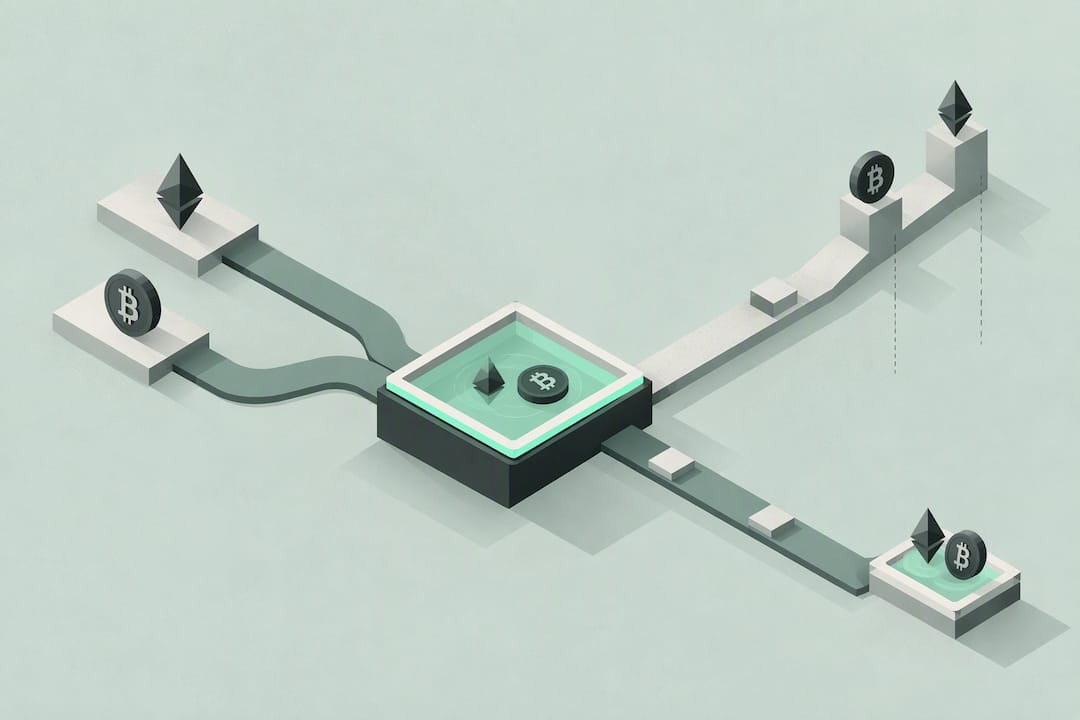
Impermanent loss is the amount by which a liquidity pool position underperforms simply holding the same assets you deposited. It does not necessarily mean your position has lost value in dollar terms. Trading fees may offset that shortfall, but whether supplying liquidity was worthwhile depends on the position’s total value after fees and costs.
What does “impermanent” mean?
When the relative price of your two deposited assets changes, a pool can leave you with a different mix of tokens than you would have held in a wallet. If the relative price returns to its entry level while your liquidity remains in a standard 50:50 pool, the price-driven difference can disappear. There is no predictable timetable for that to happen. Withdrawing while the difference exists locks in that token mix; waiting does not guarantee a recovery.
The comparison is always with holding the same deposited assets, not with your original dollar deposit or tax cost basis. Rental-property cash flow is a separate subject (40%); it provides no return estimate or evidence about impermanent loss for a liquidity pool. A pool needs its own fee and position-value accounting.
How does a pool create the difference?
In a full-range, constant-product pool such as Uniswap v2, the two token reserves are represented by x × y = k. A swap changes the reserve mix and the pool’s quoted price. Fee-paying trades also change the reserve product over time, so k is not literally unchanged across all trades.
When the pool price differs from a price available elsewhere, arbitrage traders may trade until the prices move closer together. If ETH rises relative to USDC, for example, an ETH/USDC LP ends up with less ETH and more USDC than they would have had by holding their original amounts. That is why the pool captures less of ETH’s rise. Not every swap is an arbitrage trade, and prices need not align instantly. Uniswap’s own documentation explains the Uniswap v2 pool design; arbitrage helps keep pool prices tethered to market reality. For a broader introductory discussion, see Impermanent loss in DeFi (SoK-style explainer).
Other AMMs use different designs. In concentrated liquidity, an LP chooses a price range. A narrower range can increase exposure to swap fees while the position is active, but it also concentrates the position’s exposure to price moves. If price leaves the range, that position stops accruing new swap fees until price re-enters; fees already accrued are not automatically erased.
How do you calculate impermanent loss?
For an initially equal-value, full-range, 50:50 constant-product position, assume no fees and that the pool price has adjusted to the outside market price. Let R be the new price of one asset relative to the other, divided by its price when you deposited. The position’s underperformance relative to holding is:
IL = 2 × √R ÷ (1 + R) − 1
Suppose, hypothetically, you deposit $1,000 of ETH and $1,000 of USDC, and ETH then doubles against USDC. Holding would be worth $3,000: $2,000 of ETH plus $1,000 of USDC. With R = 2, the no-fee pool position would be worth about $2,828.43. The $171.57 difference is about 5.72% of the $3,000 holding value. The pool position is still worth more than its original $2,000 value; it has underperformed holding.
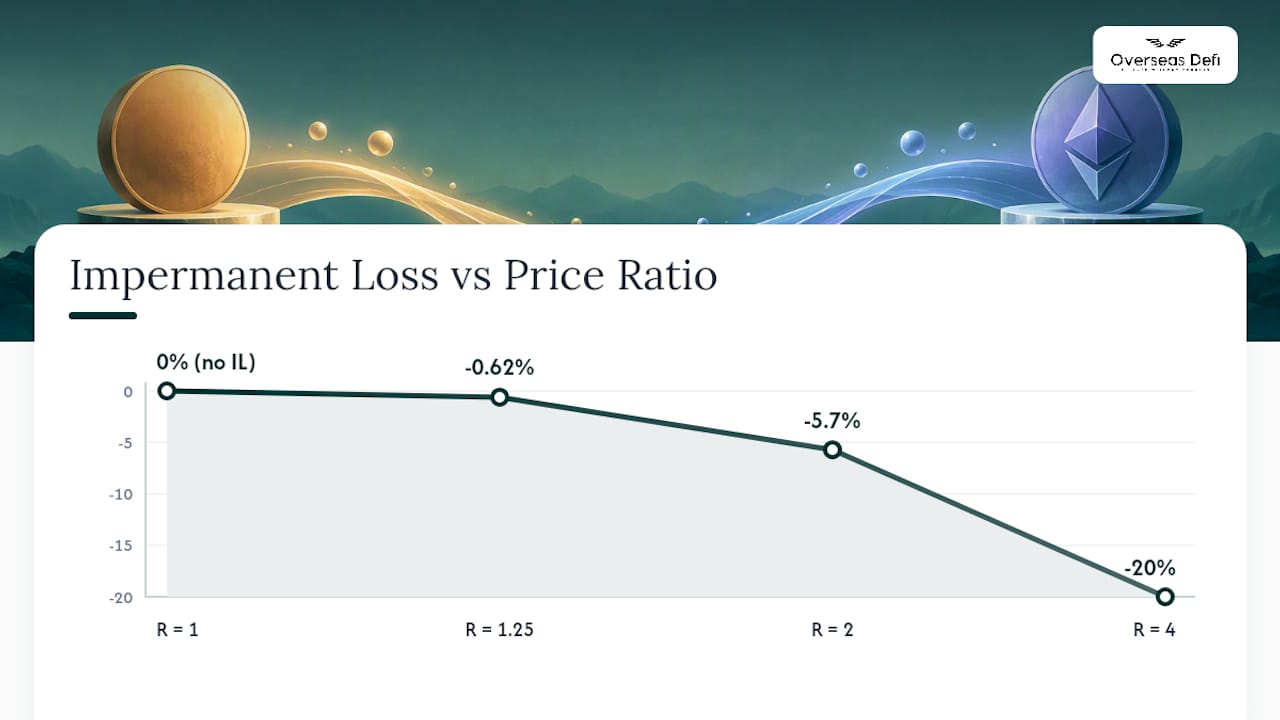
For comparison, the same formula gives about 0.62% underperformance after a hypothetical 25% relative-price rise and 20% after a fourfold rise. These are illustrations, not price forecasts. The formula does not apply unchanged to a concentrated-liquidity position or every other pool design. Uniswap’s explanation of v2 liquidity-provider returns covers the holding comparison.
Can trading fees make up the difference?
Yes, but fees offset the economic shortfall; they do not change the no-fee formula’s result for a given price ratio. Compare the value of the tokens you could withdraw, plus fees and any usable incentives, against the value of holding your original assets. Then account for transaction costs and any financing costs.
A general liquidity-pool glossary (0.05%) describes fees but does not establish a particular rate. Check the pool’s actual fee setting. For example, Uniswap v3 has standard 0.05%, 0.30% and 1% tiers, alongside other enabled tiers; fees also vary by protocol and version. Your receipts depend on your share of the liquidity that earns fees, the trades that occur while your position is active and any applicable protocol fee. Uniswap’s fee documentation explains these distinctions.
Trailing seven-day volume and fees can show what happened recently. Dividing past pool fees by total value locked may offer a rough historical pool-level comparison, but it does not predict your position’s earnings—particularly if you choose a concentrated range. Volume, active liquidity and time in range can all change. Likewise, an advertised incentive rate is not the same as a certain return: check how rewards are earned, when they become available and what the reward token is worth when you can use it.
How can you limit exposure?
- Consider relative-price risk. Assets that closely track each other may produce less divergence loss while that relationship holds. A stablecoin pair can still face depeg, issuer and smart-contract risks; low impermanent loss does not mean low overall risk.
- Understand the range. For concentrated liquidity, decide what happens if price leaves your range. You may hold a heavily one-sided position and earn no new swap fees while it remains outside.
- Check single-sided products individually. Depositing only one token may remove the need to source a second token upfront, but it does not tell you what exposure or protections the product actually provides.
- Size for an adverse outcome. A small pilot position can help you learn how fees, token balances and withdrawal costs behave without committing an amount your plan cannot tolerate losing.
- Separate borrowing from pool selection. Borrowing stablecoins against BTC or ETH does not change the chosen pool’s impermanent-loss mechanics. It adds interest, collateral and liquidation risk. If you borrow, compare potential fees with borrowing and transaction costs, monitor collateral health and consider what a sharp collateral-price fall would mean. Tax treatment depends on jurisdiction and transaction details.
The official abstract of the 2026 paper SoK: Impermanent Loss, An Unavoidable Fee or a Controlled Phenomenon? describes research into impermanent-loss models and mitigation trade-offs. Academic surveys offers a route to the paper; the abstract alone should not be taken as support for a particular pool’s outcome. For readers pursuing the formal research further, the paper is also available here: Impermanent loss: SoK / survey paper (2026).
A checklist before supplying liquidity
- Identify the pool design, assets, fee setting and, if applicable, your selected price range.
- Compare a holding baseline with your possible pool value under several relative-price moves, including moves in either direction.
- Review recent volume and fees as history, then ask how your share of active liquidity and time in range could change your receipts.
- Value incentives separately. Include deposit, adjustment and withdrawal costs; add interest and collateral risk if borrowing is involved.
- Decide in advance when you would review, adjust or exit the position. Check the protocol and asset risks as well as the fee calculation.
OverseasDeFi’s Daily Yield System uses Hold → Borrow → Deploy → Earn as a framework for assessing choices, not a requirement to borrow. Looking at holdings, debt, potential fees and position risk together can help frame better questions for a portfolio-aware AI coach or live guidance. Neither tools nor guidance can ensure that fees beat a holding strategy or prevent a loss. If borrowing is under consideration, first understand how crypto-loan liquidation works.
FAQ
Is impermanent loss the same as losing money?
No. It measures underperformance against holding the deposited assets. Your pool position can rise in dollar value while still being worth less than the holding alternative. Fees, costs and other price changes affect your overall result.
Does withdrawing cause impermanent loss?
Withdrawal does not create the price divergence. It fixes the pool’s then-current token mix as your outcome. If the relative price has moved since deposit, that mix may be worth less than holding the original amounts, before fees.
Can fees eliminate the impact?
Fees can exceed the holding shortfall for a particular position and period, but they cannot be assumed to do so. The formula-based, no-fee comparison remains the same; fees are an additional part of the net-result calculation.
Why did my liquidity position underperform?
Compare its current token amounts and accrued fees with the assets you originally deposited and would otherwise have held. Then check relative-price changes, time spent outside any selected range, incentives, transaction costs and any borrowing interest. A fall in both assets’ dollar prices can also reduce your position’s value independently of impermanent loss.