


Most people who ask about a multi-chain yield strategy have the same problem. They bought Bitcoin or Ethereum years ago, they believe in it, and they’re tired of watching it sit there while the rest of life, tuition, a mortgage, a business, keeps sending bills. They don’t want to sell. They want the coins to do some work.
A multi-chain yield strategy is simply that: putting crypto to work in more than one place, across more than one blockchain, so income doesn’t depend on a single protocol or a single network. Done carefully, it can spread risk. Done carelessly, it can multiply it. This guide explains how the pieces fit, what each one costs, and where people get hurt, so you can decide with a clear head. Our Daily Yield System teaches this step by step, starting with wallet security before any income strategy.
Overseasdefi5steps.overseasdefi.comExplore Yield Without SellingLearn how borrowing against crypto, liquidity provision, and risk management can fit into an income strategy while you keep control of your assets.5 steps to earning daily IncomeTL;DR
- A multi-chain yield strategy spreads income-producing positions (lending, liquidity provision, staking) across several blockchains instead of one.
- Borrowing against BTC or ETH can fund those positions without selling, but your health factor (the safety margin on the loan) is the number that matters most.
- An advertised APY is a starting point. Net return is what’s left after incentives fade, fees, gas, bridge costs and price moves.
- Bridges, audits and exit routes are separate risks. Size each position so a single failure is survivable.
- Start small, write the exit plan before you deposit, and treat everything as education, not a promise of returns.
Table of Contents
- What a multi-chain yield strategy actually is
- Why spread across chains at all
- The borrowing route: cash flow without selling
- From advertised APY to net return
- Where multi-chain strategies break
- Building the plan: size, monitor, exit
- Learning it with support
- Where to go from here
- FAQ
- Sources
What a multi-chain yield strategy actually is
Think of a blockchain as a country with its own banks and markets. Ethereum is one, and others like Arbitrum or Base sit on top of it or alongside it. Each has lenders, trading venues and rewards programs. A multi-chain strategy means you hold positions in several of those “countries” instead of keeping everything in one.
The yield itself comes from a short list of sources. Researchers at the Bank for International Settlements describe yield aggregators as tools that invest user funds in other DeFi protocols to maximize returns, comparing services such as lending, liquidity provision and staking. In plain terms:
- Lending: you supply an asset to a pool and borrowers pay interest to use it.
- Liquidity provision: you deposit a pair of assets into a trading pool and earn a share of the trading fees.
- Staking: you lock tokens to help secure a network and receive rewards.
The “multi-chain” part comes from a practical fact. A DefiLlama research report notes that yield optimization means choosing among lending, liquidity, staking and other strategies across chains, and that when an allocator only works on one chain, you have to bridge your funds to chase opportunities elsewhere. Bridging is where much of the extra risk lives, which we’ll get to.
If you want the foundation first, our guide on how to earn yield without selling your Bitcoin or Ethereum covers the basic mechanics in one place.
Why spread across chains at all
There are three honest reasons, and one bad one.
Concentration risk. If all your positions sit in one protocol and it has a bug, everything is exposed together. Splitting across independent protocols means one failure doesn’t take the whole plan down. We cover this in more depth in diversification in DeFi for BTC and ETH holders.
Cost. Activity on Ethereum’s main network can be expensive in fees. Many holders use layer 2 networks, which are cheaper add-on networks built on top of Ethereum, for the smaller, more frequent moves.
Opportunity. Different chains pay different rates for the same kind of work, at different times.
The bad reason is chasing the highest number on a dashboard. Rates that look generous are usually paid in a project’s own token, and that token’s price can fall faster than your yield accrues. More chains also means more moving parts to watch. If you can’t describe each position in one sentence, you probably have too many.
The borrowing route: cash flow without selling
One route the Daily Yield System framework examines is borrowing against your BTC or ETH instead of swapping it into something else, but only if borrowing fits your circumstances. You post your coins as collateral, take out a loan in a stablecoin (a token designed to track the dollar), and deploy that loan into the yield positions. Your original coins stay yours and keep their long-term exposure. That’s the core of the idea behind the Daily Yield System.
Here’s the part that deserves your full attention: the loan has to stay safely over-collateralized. On Aave, one of the largest lending protocols, the safety margin is called the health factor. Aave’s documentation defines it as total collateral value times the weighted average liquidation threshold, divided by total borrowed value, and says a reading below 1 puts the position at risk of liquidation.
Here’s a simple worked example, with the math extended. Suppose you supply $10,000 of ETH as your only collateral, with an 80% liquidation threshold, and borrow $6,000. Your health factor is 1.333. Holding the debt constant, your position hits 1 when your collateral is worth $7,500 (that’s $6,000 divided by 0.8). That’s a 25% drop in ETH’s price, and ETH has had sharp drawdowns of that size before.
So a sensible plan doesn’t borrow near the limit. Many careful holders borrow a fraction of what’s allowed, so a sharp drop still leaves room to add collateral or repay. Three things to keep straight:
- Collateral risk: the price of what you posted can fall.
- Interest-rate risk: borrowing rates on these platforms float, so your cost can rise while your yield doesn’t.
- Liquidation risk: if the health factor falls below 1, a liquidator can repay part, or in some cases all, of your debt and receive the matching value of your collateral plus a liquidation bonus. You lose coins you meant to keep.
We go deeper on this in our guide to reducing debt when your margin shrinks.
From advertised APY to net return
APY is the yearly rate a platform shows you, including compounding. It’s a snapshot, not a contract. Before you commit capital, turn the headline into a net figure with a simple routine.
Step 1: Split the yield by source
A 12% number might be 4% from trading fees or borrower interest and 8% from reward tokens. The first part comes from real activity. The second is a subsidy that can shrink or end, and it’s paid in a token whose price moves. Treat the reward part as temporary until proven otherwise.
Step 2: Subtract what you pay
List every cost: the interest on your loan if you borrowed, network fees (gas) each time you deposit, claim or withdraw, and bridge fees if funds cross chains. Small accounts feel gas the most. A $50 fee on a $2,000 position is 2.5% gone before the first day of yield.
Step 3: Account for price moves
In a liquidity pool holding two assets, a change in their relative prices can leave you with less value than if you’d simply held. That gap is often called impermanent loss. Our explainer on yield farming vs. liquidity mining shows how the two terms differ and what each exposes you to.
Step 4: Set a realistic target
A worked example makes the logic concrete. Say a pool shows 10% APY, half of it in reward tokens. Plan around the 5% from fees. Subtract 1% for gas and rebalancing over the year. You’re at about 4% before any price effects. If the position is funded with a loan, subtract the borrow rate too. A hypothetical 5% borrow cost would turn this into a small loss before price effects. That’s a very different story than the headline, and it’s the number that belongs in your budget. For benchmarks on what’s reasonable, see realistic crypto yields and safe yield targets.
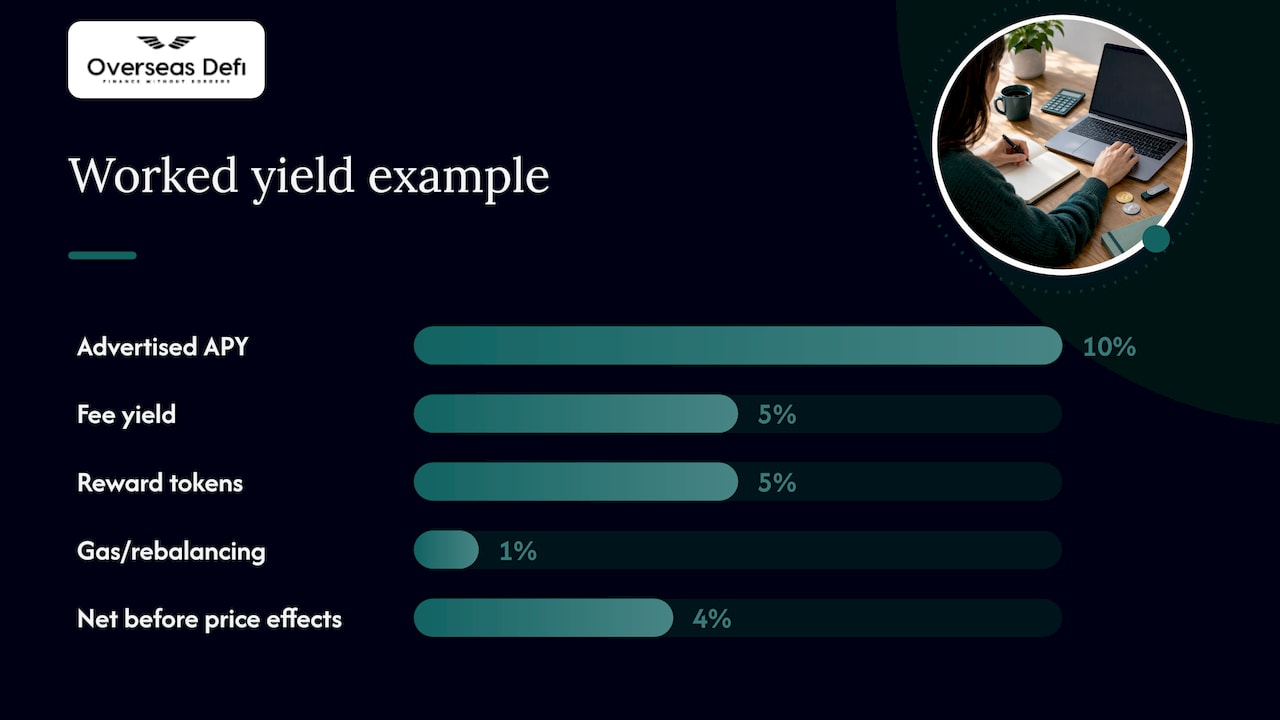
The example is arithmetic, not a forecast. Actual rates change constantly, so read the live numbers on the protocol’s own page on the day you act.
Where multi-chain strategies break
Multi-chain adds risks that a single-chain plan doesn’t have. Here are the main ones in the order they tend to show up.
Bridges
A bridge moves value from one chain to another. At least one regulator has proposed treating the result as its own exposure. The Abu Dhabi Global Market’s financial regulator, in its proposed DeFi risk guidance, says bridged or wrapped assets should be treated as distinct exposures, with attention to custody, the bridge’s trust assumptions, recovery routes and possible price divergence from the original asset. A wrapped token is an IOU for the real one. If the IOU’s backing is questioned, its price can slip below the asset it represents.
Not every cross-chain system works the same way. A LlamaRisk analysis of Aave’s integration with Chainlink’s cross-chain protocol describes a lock-and-mint flow for moving GHO from Ethereum to Arbitrum, with tokens burned on Arbitrum and released on Ethereum on the way back, and a monitoring network able to pause the system if it detects anomalies. The takeaway for you: know which design a bridge uses before you send anything. Our checklist, crypto bridge risk: what to check before a transfer, walks through it.
Smart-contract and oracle risk
Smart contracts are the code that holds your funds. Oracles are the feeds that tell that code what prices are. If either fails, you can lose money even when your own decisions were sound. Read more in DeFi oracle risk.
Audits aren’t a safety certificate
An audit is a review of code by outside specialists. It’s useful, and it’s also limited. The proposed ADGM guidance says audits give point-in-time assurance over a defined scope, can miss new attack vectors, and lose validity when the code changes. A protocol that was audited a year ago and has since been upgraded isn’t the protocol that was audited. Audits in any field share a similar limit: they cover a defined scope at a point in time. For a general, non-crypto perspective, see audit scope and changing code. Our own walkthrough, how to read smart contract audits, gives you five checks to run on any report.
Custody and your own keys
In DeFi you hold your own keys, so mistakes are yours to carry. Know exactly what you control and what you don’t in each place your coins sit.
Building the plan: size, monitor, exit
The regulator’s proposed guidance, written for regulated firms, makes a point worth borrowing even if you’re a private individual. It cautions that relying only on being able to exit after a stress event is not enough, because exit routes can become unavailable, uneconomical or unsafe. It calls for controls such as position sizing and exposure limits set in advance. In everyday terms: decide how much you can afford to be wrong before you deposit, not after the screen turns red.
A workable framework looks like this:
- Decide the slice. Choose a share of your BTC or ETH to put to work. Many holders keep the majority untouched. Only you know your family’s cash needs and your tolerance.
- Cap each position. Set a maximum per protocol and per chain, so no single failure is a disaster.
- Borrow conservatively. Keep your health factor well above 1, with room to add collateral if prices fall.
- Limit the number of chains. Two or three you understand beat six you don’t.
- Monitor on a schedule. Check health factors, reward rates and any protocol announcements at set times, not whenever you feel anxious.
- Write the exit first. Know the steps, the fees and the order in which you’d unwind. Our guide to exit strategy for DeFi shows how.
- Plan for taxes. In the US, staking and similar rewards are generally treated as income when you gain control of them, with gain or loss when you later sell. Borrowing, LP deposits and other transactions can raise separate tax questions, and outcomes depend on your jurisdiction and transaction details. Our page on US tax on crypto interest and rewards explains the general pattern, and it’s worth reviewing your own situation with a CPA.
For the protection side, our guide to DeFi insurance and what it covers is a good place to begin, alongside our broader crypto risk management guide. For the calendar side, such as when income arrives and when costs come due, see yield schedule planning.
Learning it with support
None of this is hard to understand, but it’s easy to get wrong when you’re doing it alone on a Sunday night with real money. That’s why we built OverseasDeFi as education, tools and coaching. You keep control of your assets and make your own decisions. We don’t take custody of funds or manage investments for you.
There are two ways to work with us. Community and Accelerator offer different levels of support, from self-paced learning to more hands-on guidance. Members have access to portfolio tools and an AI coach that can draw on portfolio context. Seeing holdings, debt and health factor together helps you ask better questions about adverse-price scenarios. The tools support your own decisions; they can't prevent liquidation or guarantee complete or current data.

You can see both paths on the OverseasDeFi site, or read the Accelerator details if you want more hands-on guidance. And the free guides in our learning library are there whether or not you ever join.
Where to go from here
If you’re deciding what to do this week, here’s a low-key next step. Write down three numbers: how much BTC or ETH you’d consider putting to work, the largest drop in price you could absorb without losing sleep, and the monthly cash you’d actually like it to produce. Those three numbers decide most of the strategy before you ever open a protocol.
Then read the exit and bridge guides above, and start smaller than feels necessary. No yield is guaranteed, and anyone who says otherwise is selling something. If you’d like company while you work it out, we’re happy to have you. If not, we hope the guides save you a few expensive lessons.
FAQ
Is a multi-chain yield strategy safer than staying on one chain?
It can reduce concentration risk, because one protocol’s failure doesn’t hit everything. It also adds bridge, wrapped-asset and monitoring risk. Safety comes from position limits and a tested exit plan, not from the number of chains.
Can I earn yield on Bitcoin without selling it?
Yes, in principle. Many holders post BTC or a wrapped version as collateral, borrow a stablecoin and deploy that loan. Wrapped Bitcoin is a different asset from the real thing and carries its own custody and price risks, so treat it as a separate exposure.
How much of my crypto should I put to work?
There’s no universal number. A common approach is to start with a small slice you could afford to see drop sharply in value, then cap each protocol and chain. Your family’s cash needs and your time horizon should set the figure.
What’s the biggest mistake beginners make?
Borrowing too close to the limit. A modest price drop then pushes the health factor toward 1 and can trigger liquidation. Leaving a wide cushion and monitoring it on a schedule lowers that risk, though it can't remove it.
OOverseasdefiDiscuss Your BTC or ETH StrategyReach out to ask about learning to use your Bitcoin or Ethereum for income while understanding the risks and keeping control of your assets.Roman.rida@overseasdefi.com+1 310 569 7547Sources
- The Technology of Decentralized Finance (DeFi), Bank for International Settlements
- Solving the DeFi Yield Maze: The Rise of Gen 3 Optimizers, DefiLlama Research
- Health Factor & Liquidations, Aave
- DeFi Risk Management Guidance (proposed), ADGM Financial Services Regulatory Authority
- Aave explainer series: Chainlink CCIP and its integration, LlamaRisk
Recommended
- Realistic Crypto Yields: What Bitcoin and Ethereum Holders Can Expect
- Concentrated Liquidity Strategies: A Plain-English Guide for BTC and ETH Holders
- Bitcoin DeFi Yield: How BTC Holders Can Earn, and What Can Go Wrong
- Before You Deposit BTC or ETH: Yield Farming vs. Liquidity Mining
This article is for educational purposes only and is not personalized financial, investment, tax or legal advice. Crypto and DeFi involve significant risks, including market volatility, liquidation, smart-contract failures and loss of capital. Income, yields and asset appreciation are not guaranteed. Past performance does not predict future results. Examples are illustrative, not promises of what you will earn. OverseasDeFi provides education, tools and coaching; we do not take custody of your assets or manage investments for you.