


Put 5% of a portfolio in Bitcoin and it feels like a small bet. It isn’t. In one institutional analysis, a 5% bitcoin slice in a classic 60/40 portfolio accounted for roughly 17% of the portfolio’s total risk. The dollars looked tiny. The risk didn’t.
That gap is what risk parity is about. Instead of asking “how many dollars go in each asset?”, you ask “how much of my portfolio’s risk comes from each asset?” For crypto holders, especially those who want their coins to earn cash flow without selling, it’s a sturdy way to think about position size. Below we cover what it means, how to do the math with a worked example, what research shows (including where it disappoints), and how to use the idea without turning it into a religion.
This is education, not investment advice. You make the decisions.
Overseasdefi5steps.overseasdefi.comSize Crypto Positions With Risk in MindExplore how practical education, portfolio tools, and human support can help you understand crypto income strategies and their risks.5 steps to earning daily IncomeTL;DR
- Risk parity sizes each asset so it contributes roughly the same share of portfolio risk, rather than the same share of dollars.
- The simplest version is inverse-volatility weighting: the wilder the asset, the smaller its slice.
- Research is mixed. Risk-based sizing can reduce downside risk, but it also limits upside, and one 2026 working paper reports that diversified risk-based strategies lagged Bitcoin and Bitcoin-heavy allocations in the post-COVID period.
- Rebalancing costs matter. Fees, slippage and taxes can meaningfully reduce returns, especially with frequent trading.
- For income strategies, the same thinking helps you size collateral, loans and liquidity pool deposits so no single position can sink the plan.
Table of Contents
- What risk parity means for a crypto portfolio
- Why a small Bitcoin slice is a big risk slice
- The math, in plain English
- What the research says (and where it disagrees)
- How often to rebalance, and what it costs
- Crypto-specific ways risk parity can fail
- Using risk parity thinking for a borrow-and-earn plan
- Where OverseasDeFi fits
- FAQ
- Sources
What risk parity means for a crypto portfolio
Risk parity is a way of building a portfolio where each asset’s contribution to total risk is roughly equal, rather than each asset getting equal capital. The simplest implementation is inverse-volatility weighting: high-volatility assets such as BTC get smaller capital weights than calmer ones. A Binance Research report applies risk parity thinking to a crypto index.
An everyday analogy helps. Picture a household budget where you split every expense category equally by dollars: $1,000 on groceries, $1,000 on rent, $1,000 on that one hobby you swear is under control. Now picture splitting by how much each category can blow up your month. The hobby gets a much smaller allowance. Same idea.
A more formal definition comes from a Stanford paper by Johansson and Boyd. They define risk parity as the case where every asset contributes an equal fraction of total portfolio risk. A nice practical feature: the method doesn’t need a forecast of expected returns. You only need estimates of volatility and how assets move together, which are far easier to measure than the future.
Why a small Bitcoin slice is a big risk slice
Volatility is how much an asset’s price swings, usually quoted as an annualized percentage. In the Stanford sample (September 2017 to September 2024), Bitcoin ran at about 58.1% volatility with an 83.3% drawdown, and Ether at 71.6% with a 93.9% drawdown. The four traditional industry portfolios in the same study ran around 18% to 24% volatility. A drawdown is the drop from a peak to a low, so 83.3% means an investor who bought at the top watched most of it vanish before recovery.
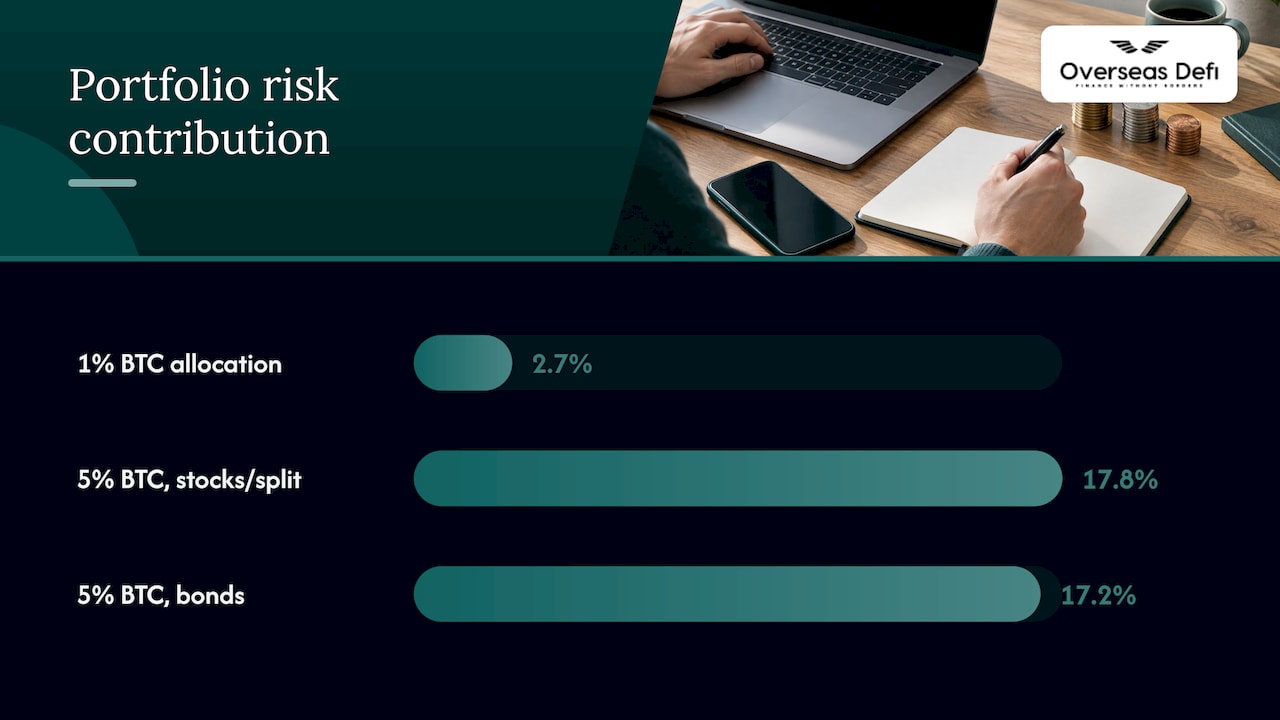
Fidelity’s institutional research (data from January 2018 to March 2024) puts numbers on what that does inside a 60/40 portfolio:
- A 1% bitcoin allocation contributed about 2.7% of total portfolio risk.
- A 5% allocation made up 17.8% of portfolio risk when funded from stocks or split equally, and 17.2% when funded from bonds.
- Risk rises faster than the allocation does.
So if you hold most of your net worth in BTC and ETH already, you’re not “diversified with a bit of crypto”. You’re a crypto portfolio with a side of everything else. Risk parity makes that visible.
The math, in plain English
You don’t need a quant degree. You need two ideas.
Idea one: inverse volatility. Each asset’s weight is proportional to one divided by its volatility. Written out, it’s the asset’s 1/σ divided by the sum of every asset’s 1/σ; the pyeconomics documentation covers this and related risk-based allocation methods.
Idea two: equal risk contribution. Inverse volatility ignores correlation, meaning how closely assets move together. True risk parity solves for weights so each asset’s contribution to portfolio volatility is equal, which takes a numerical solver. Either way, the output is a model built on estimates, not a verdict.
Worked example: BTC and ETH only
Use the Stanford volatilities: BTC 58.1%, ETH 71.6%.
- Inverse volatilities: 1/58.1 = 0.01721 and 1/71.6 = 0.01397.
- Sum: 0.03118.
- BTC weight: 0.01721 / 0.03118 = about 55%. ETH weight: about 45%.
So inside your crypto sleeve, a simple inverse-volatility split leans roughly 55/45 toward Bitcoin. That’s an illustration of the method with one study’s figures, not a recommendation. Real volatility estimates change with the window you pick, and BTC and ETH are highly correlated, so this split doesn’t diversify as much as it looks.
Worked example: crypto next to something calm
Now add a hypothetical low-volatility holding at 6% volatility (think short-term Treasury-like). Its inverse is 0.1667. Add BTC’s 0.01721 and the sum is 0.1839. BTC gets about 9% of capital, the calm asset about 91%.
That’s the uncomfortable truth of risk parity with crypto: it asks for very small capital weights. Binance Research notes a related trade-off: simple risk parity limits upside as well as downside. Volatile assets get squeezed hard.
What the research says (and where it disagrees)
The evidence is mixed, and you should know both sides before you borrow any ideas from it.
The case for. A 2019 study by Burggraf found that most risk-based strategies outperformed individual cryptocurrencies and an equally weighted portfolio. A 2026 study by Cesarone and colleagues looks at whether adding large-cap cryptocurrencies to equity portfolios helps, including under risk parity. As with any backtest, transaction costs and liquidity can change how results play out in practice.
The Stanford team found that a combined portfolio with a 10% annualized risk limit and a 10% cap on crypto weight earned 8.2% with 8.2% volatility and a Sharpe ratio of 1.00, against 6.0% and 0.73 for the industry-only portfolio, per their published paper. The Sharpe ratio is return per unit of risk, so higher is better. Worth knowing: because of the 10% crypto cap, the combined portfolio held about a third of its value in cash on average, and the crypto-only portfolio about 90%.
The case for caution. A Ross and co-authors study found that traditional risk-based strategies, including equal risk contribution, did not significantly boost performance. They also showed that strong paper returns could largely disappear once realistic liquidity limits were applied.
In a June 2026 working paper, diversified hierarchical risk parity variants performed very similarly to one another over the full sample. In the post-COVID period, however, they lost heavily, while Bitcoin and Bitcoin-heavy allocations held up better.
And risk parity caps the upside along with the downside. A strategy that gives volatile assets tiny weights will usually trail those assets in strong rallies, even as it cushions the falls.
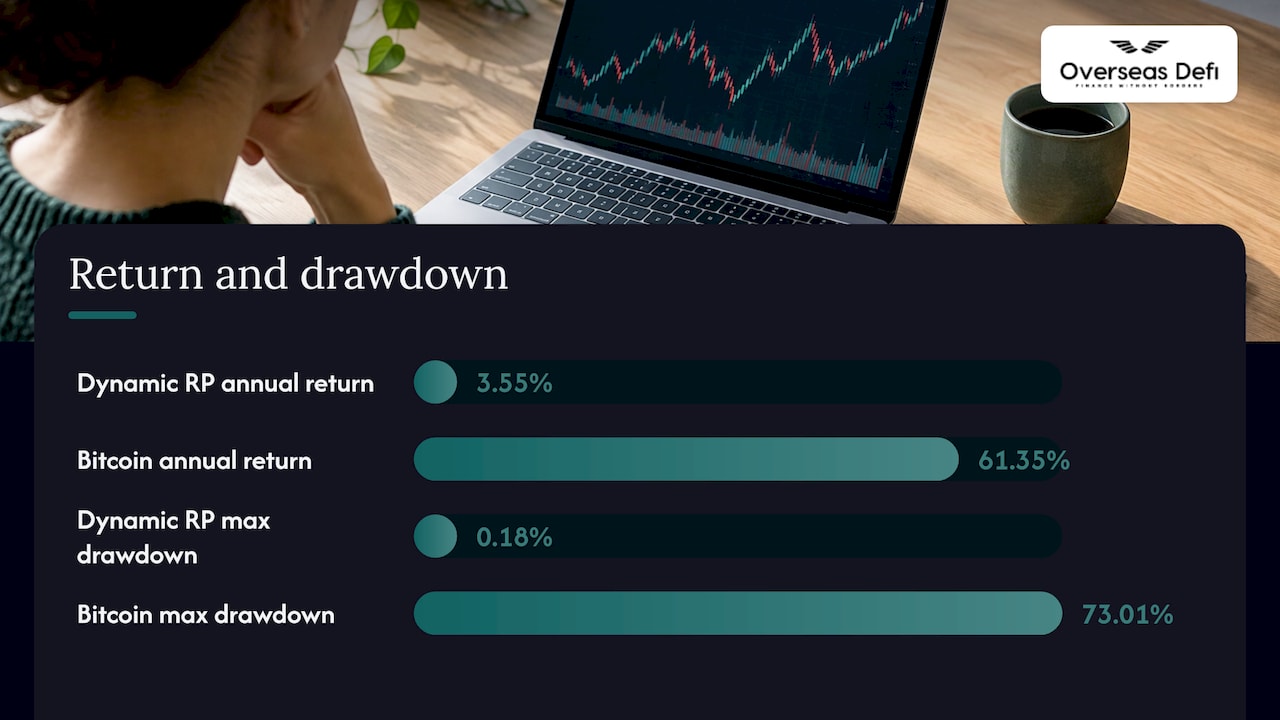
The takeaway: risk parity isn’t a return engine. It’s a discipline for deciding how big each position is, best used as a lens rather than a formula to follow blindly.
How often to rebalance, and what it costs
Rebalancing means trading back to your target weights after prices drift. There’s no single correct frequency; what matters is a rule you can keep and the costs it creates.
The cost side is real, though. A 2025 Frontiers paper by Veliu and colleagues examines how transaction costs affect minimum-risk portfolios; the broad lesson is that costs can meaningfully reduce returns, especially with frequent trading. For someone running DeFi positions, add gas fees, slippage and the tax consequences of selling. Rebalance on a schedule or when a position drifts past a band you chose in advance, not every time the market twitches. Our guide to rebalancing crypto income walks through the practical routine.
Crypto-specific ways risk parity can fail
A few things the textbooks understate:
- Correlations spike in a crash. Assets that looked independent move together exactly when you need them not to. Our piece on cross-protocol diversification covers why spreading across protocols isn’t the same as spreading risk.
- Volatility estimates lag. A model built on the last 63 or 250 days can underrate a coming storm.
- Liquidity isn’t guaranteed. The liquidity-constrained results from the Petukhina, Trimborn, Härdle and Elendner study described above are the warning label.
- Smart contract and custody risks aren’t volatility. No covariance matrix captures a drained pool or a compromised wallet. See custody risk in DeFi.
Using risk parity thinking for a borrow-and-earn plan
If you’re reading this, you probably don’t want to sell your Bitcoin or Ether. You’d rather borrow against it and put the proceeds to work. The risk parity mindset fits that setup well, because every layer adds its own risk and you want each one sized on purpose.
Here’s a simple way to apply it without running a solver:
- Start with the big risk, your collateral. Your BTC and ETH are the volatile assets. Decide what share of your total net worth they represent, and how you’d feel about an 80% drop. The drawdown figures above aren’t hypothetical.
- Size the loan against that volatility. The more volatile the collateral, the lower your loan-to-value should sit. Our guide to stress-testing your LTV and the explainer on how liquidation works show how to test it.
- Cap each deployment. Rather than putting every borrowed dollar into one liquidity pool, set a ceiling per position, per protocol and per asset type. The pre-deposit check for liquidity pools is a useful habit before each deposit.
- Keep a calm bucket. Cash-like reserves lower your total risk and keep you from being a forced seller. We cover this in emergency funds in crypto.
- Rebalance by rule. Pick a schedule or drift band, write it down, and stick to it.
For the sizing step in detail, see how to size BTC and ETH income positions, and for the overall frame, crypto risk management for BTC and ETH holders.
Borrowing against crypto carries liquidation risk, and yields from liquidity pools aren’t guaranteed. Nothing here promises a return. If tax treatment of loans or pool income is part of your plan, check it with a qualified tax professional in your country.
Where OverseasDeFi fits
Turning this from a concept into a routine is the hard part, and it’s what our Daily Yield System is built to teach, starting with wallet security before any income strategy: how to decide whether to keep crypto exposure, whether borrowing fits your situation, and whether net income justifies the combined risks. Our portfolio tools help you see holdings, debt and risk together, and our AI coach can use the portfolio information you track to ground its answers. It supports your decisions; it doesn’t replace them.
Community and Accelerator offer different levels of support, from self-paced learning and tools to more structured, hands-on coaching. Coaching, community and macro calls are part of how we teach. We provide education, tools and coaching; we are not an investment manager, and you make your own decisions.

If you’d like to see how the paths compare, take a look at Community and Accelerator. No pressure. Reading our free DeFi cash flow guides first is a perfectly good next step.
FAQ
Is risk parity the same as diversification?
Not quite. Diversification spreads money across assets, often equally. Risk parity spreads risk, so volatile assets like BTC and ETH get smaller dollar weights. Two assets that move together still count as one risk, which is why correlation matters.
Can I do risk parity with only Bitcoin and Ether?
You can size them against each other, as in the 55/45 example above. But BTC and ETH are highly correlated, so you’d be balancing two versions of the same risk. The bigger sizing question is how much of your total net worth sits in crypto at all.
How often should I rebalance a risk-based portfolio?
There’s no single correct schedule, so choose a rhythm you can actually keep, or rebalance only when a position drifts past a band you set in advance. Account for gas, slippage and taxes, since trading costs can meaningfully reduce returns, especially with frequent trading.
Does risk parity guarantee lower losses?
No. It aims to limit how much any one asset can hurt you, based on past volatility and correlation. Those can change fast in a crash, and smart contract or custody problems aren’t captured by the math. Treat it as a sizing guide, not a guarantee.
OverseasdefiDiscuss Risk in a Borrow-and-Earn PlanReach out to discuss how OverseasDeFi’s education and coaching can help you understand borrowing against crypto and the risks involved.OOverseasdefiEmail usRoman.rida@overseasdefi.com+1 310 569 7547Sources
- Crypto Synthetic Index for All Market Conditions (Binance Research)
- Simple and Effective Portfolio Construction with Crypto Assets (arXiv)
- Simple and Effective Portfolio Construction (Stanford)
- Considerations for including bitcoin (Fidelity Institutional)
- Risk-based allocation documentation (pyeconomics)
- Risk-Based Portfolio Optimization in the Cryptocurrency Market (SSRN)
- Cryptocurrencies in equity portfolios: trend or opportunity? (Cesarone et al.)
- Investing with Cryptocurrencies (arXiv)
- UCEMA working paper dt928 (June 2026)
- On transaction costs in minimum-risk portfolios (Veliu et al., 2025)